| site search by freefind | advanced |
- Home
- Learn To Read
Learn To Read
Note: If you purchase anything from links on this site, I may make a commission.
Join our Facebook page.
Everyone who can speak English can learn to read. It does not matter if you are an adult who struggles with reading or a preschool student wanting a head start; our program will teach you the skill of reading. We will show you how to read everything you desire in simple and easy steps. You can develop or sharpen your reading skills with our one-on-one reading program. You will be able to enhance your education on any subject of interest or have adventures beyond your wildest imagination. Books can take you there - if you can decode their words.
---Watch a short YouTube presentation here---
Reading is not complicated. If you are struggling with reading basics, you may not believe that statement. You may have put out your best efforts and still failed. You may have tried many other programs, including phonics programs, and yet effective reading evades you or a loved one. It does not have to be that way. If you can speak English, you can learn to read English. As with all things in life, it will be easier for some than for others, but you [or your loved one] can make your dream of literacy come true. Don't let past failures or discouragements stop you!

Many people find reading frustrating, difficult, or mentally straining. The main reason for this is that they are reading the wrong way! It is not their fault. They are only doing what they have been taught. A little over 100 years ago, almost everybody could read well. In fact, the Puritans taught their children to read around the age of four. Then a “new and improved” method was introduced, drastically reducing reading skills!
Popular teaching methods in schools all over North America tell students to memorize words. These are called sight words. Students are expected to learn to read by memorizing common words. Some students have excellent memories and will do well in this system, but many will not. They will struggle and hate reading. Performance in other subjects will likely suffer because of poor reading skills. Some will not learn to read at all and try to cover up what they consider to be an embarrassing failure. However, EVERY single student - no matter how good their memory - will be limited. Consider that the English language has between 750,000 and 1,000,000 words. No one can memorize all those words! But with our method, anyone can easily learn to read the majority of them.
Learn To Read Correctly
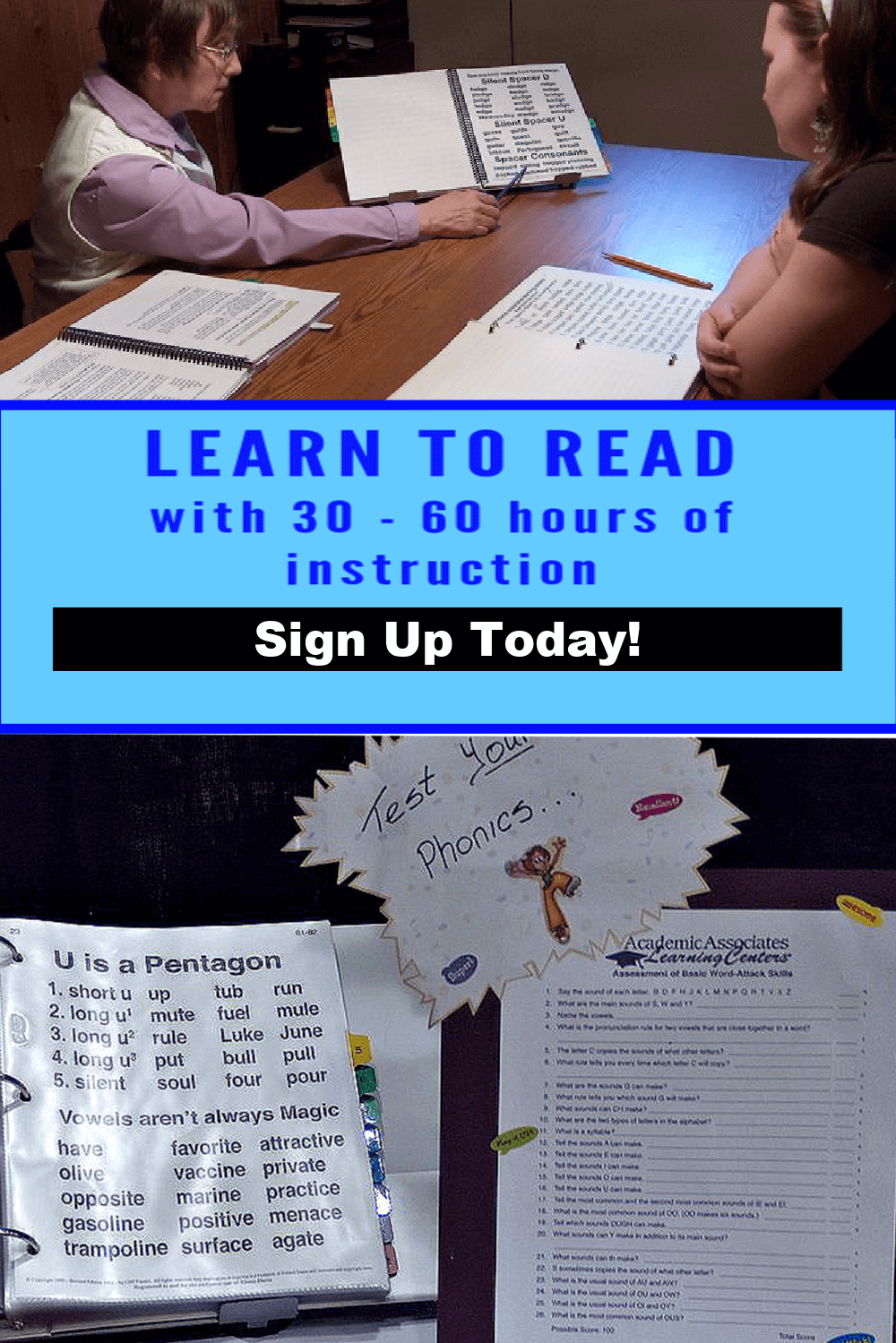
The correct way to learn to read is called phonics. Phonics is simply understanding the sounds that letters make and putting them together to form words. There are only 44 sounds in the English language. Anyone who speaks English already knows all the sounds; learning to read is just a matter of learning which letters make which sounds and when. As students progress through our course, they receive reminder rule cards to help them remember what they are learning. These are easy reference guides for them to keep.
English is one of the most colourful and descriptive languages on earth. We borrow words from other languages and adopt them into our own. Despite this, almost 90% of English words are either totally phonetic or have large phonetic parts. A few words are exceptions [like 'one'], but these words can be easily learned. If you enroll in our program, you will have a one-on-one Reading Instructor Specialist to guide you into the wonderful world of words.
Although many phonics learning centers and programs are effective with reading help, some students still struggle with reading. The main reason is that they do not teach all the phonetic rules or do not put them in a simple, easy-to-understand order. Some phonics is better than no phonics, but many students will still find reading frustrating without a complete, easy-to-learn system. This is not an ongoing tutoring system. This is a complete program with a beginning and an end. We will train you with the tools you need to master reading and continuously develop your skills even after graduating.
We use the Academic Associates systematic phonetic program. With these easy steps, everyone who can speak English [98% effective] can be reading with only 30 - 60 hours of instruction [on average]. In fact, it will come automatically. By the time the first lesson is complete, everyone will have read 300 words! Some schools take an entire year to accomplish what we can usually do in a few hours. So, if you have been discouraged with reading, don't give up. Reading help is here. You can learn to read or improve your reading skills. Check out our FAQ, then contact us today for more information.
For a list of all our articles on reading, go to our Learn To Read Sitemap.
Check us out on Facebook:
Facebook: Learn To Read Prince George and the World.
For all the details, see our Frequently Asked Questions page.

Recent Articles


-
Just The Nicest Person by Christy Barritt
Mar 22, 24 12:59 PM
Just The Nicest Person launches Christy Barritt’s 8-book series, True Crime Junkies. In this book, we meet Andi, who has taken a job as an ice road trucker -
The War In The Shadows by Charles Whiting
Mar 12, 24 09:22 PM
The War In The Shadows is an exciting book about the spymasters of World War II. Enter into a devious world where you don’t know who to trust, and one -
Bell Mountain by Lee Duigon
Feb 21, 24 01:20 PM
Bell Mountain by Lee Duigon Bell Mountain is a Christian fictional fantasy. Jack lives a a small town with his uncaring uncle. He begins to have dreams
